Echos from a distant mountain

Saturday, October 28, 2006

Go drink some tea

Blatently robbed from Creative Ireland. Here's a prime example of "Men Are From Mars, Women Are From Venus," supposedly offered by an English professor from the University of Colorado for an actual class assignment:

The professor told his class one day: "Today we will experiment with a new form called the tandem story. The process is simple. Each person will pair off with the person sitting to his or her immediate right.
As homework tonight, one of you will write the first paragraph of a short story. You will e-mail your partner that paragraph and send another copy to me. The partner will read the first paragraph and then add another paragraph to the story and send it back, also sending another copy to me. The first person will then add a third paragraph, and so on back-and-forth.

Remember to re-read what has been written each time in order to keep the story coherent. There is to be absolutely NO talking outside of the e-mails and anything you wish to say must be written in the e-mail.The story is over when both agree a conclusion has been reached."

The following was actually turned in by two of his English students: Rebecca and Gary.

THE STORY: (first paragraph by Rebecca)
At first, Laurie couldn't decide which kind of tea she wanted. The chamomile, which used to be her favorite for lazy evenings at home, now reminded her too much of Carl, who once said, in happier times, that he liked chamomile. But she felt she must now, at all costs, keep her mind off Carl. His possessiveness was suffocating, and if she thought about him too much her asthma started acting up again. So chamomile was out of the question.

(second paragraph! by Gary)
Meanwhile, Advance Sergeant Carl Harris, leader of the attack squadron now in orbit over Skylon 4, had more important things to think about than the neuroses of an air-headed asthmatic bimbo named Laurie with whom he had spent one sweaty night over a year ago. "A.S. Harris to Geostation 17," he said into his transgalactic communicator. " Polar orbit established. No sign of resistance so far..." But before he could sign off a bluish particle beam flashed out of nowhere and blasted a hole through his ship's cargo bay. The jolt from the direct hit sent him flying out of his seat and across the cockpit.

(Rebecca)
He bumped his head and died almost immediately, but not before he felt one last pang of regret for psychically brutalizing the one woman who had ever had feelings for him. Soon afterwards, Earth stopped its pointless hostilities towards the peaceful farmers of Skylon 4. "Congress Passes Law Permanently Abolishing War and Space Travel", Laurie read in her newspaper one morning. The news simultaneously excited her and bored her. She stared out the window, dreaming of her youth, when the days had passed unhurriedly and carefree, with no newspaper to read, no television to distract her from her sense of innocent wonder at all the beautiful things around her. "Why must one lose one's innocence to become a woman?" she pondered wistfully.

(Gary)
Little did she know, but she had less than 10 seconds to live. Thousands of miles above the city, the Anudrian mothership launched the first of its lithium fusion missiles. The dimwitted wimpy peaceniks who pushed the Unilateral Aerospace Disarmament Treaty through the congress had left Earth a defenseless target for the hostile alien empires who were determined to destroy the human race. Within two hours after the passage of the treaty the Anudrian ships were on course for Earth, carrying enough firepower to pulverize the entire planet. With no one to stop them, they swiftly initiated their diabolical plan.

The lithium fusion missile entered the atmosphere unimpeded. The President, in his top-secret mobile submarine headquarters on the ocean floor off the coast of Guam, felt the inconceivably massive explosion, which vaporized poor, stupid Laurie.

(Rebecca)
This is absurd. I refuse to continue this mockery of literature. My writing partner is a violent, chauvinistic semi-literate adolescent.

(Gary)
Yeah? Well, my writing partner is a self-centered tedious neurotic whose attempts at writing are the literary equivalent of Valium. " Oh, shall I have chamomile tea? Or shall I have some other sort of F--KING TEA??? Oh no, what am I to do? I'm such an air headed bimbo who reads too many Danielle Steele novels!"

(Rebecca)
As*h@le.

(Gary)
B*tch!

(Rebecca)
F**K YOU - YOU NEANDERTHAL!!

(Gary)
In your dreams, Ho. Go drink some tea.

(TEACHER)
A+ - I really liked this one.

Friday, October 27, 2006

Trip the light fantastic


And this band don't have a deal??

Thursday, October 26, 2006

Japanese dreams


What can I say about Japan? I have a love hate relationship with this place. I love the aesthetic, both real and imagined, both modern and historical. I love the mentality of the place, the creativity of the people and sense of the spiritual that pervades all. I love the way it looks, the way it feels. I even love the weather both hot and cold, dry and humid. I love the practicality and pragmatism of the thinking behind the way the society works. I particularly like the way the trains run on time. Not sort of on time, I mean to the second. I love Japanese food, and in particular I love the Japanese breakfast, complete with natto, a statement that gets the strangest of looks from Japanese people. (Natto is made from fermented soybeans and has, ahem, an acquired taste and texture).

Most of all, I love the diversity of the place. I have spent the last few years travelling and writing about the places I have visited for my job. I’ve visited many countries but nowhere is like Japan.

As the world moves with crushing inevitability towards a global monoculture, it’s refreshing to visit somewhere that is truly unlike anywhere else, or at least is still more like itself than anywhere else. To land in Japan is to arrive on a foreign planet – and I am only beginning to feel like I’ve started to get a feel for the place after many trips. Even so, I know it’s merely the omote, or the outer face, of the society that I am seeing.

More than anywhere else, this society places great store on the disparity between the Ura and the Omote (inner and outer), the Tatamae and the Honne. Tatamae means façade and refers to a person, culture or institution's public face, the position it projects to the outside world, versus the honne, which refers to it’s inner/true feelings. Japanese society places a lot of store in the maintenance of harmony in the group and often maintaining an illusion of harmony can take precedence over the interests of the individual. This happens in other places in the world and in other cultures as well, but here's it's raised to an art form.

One famous proverb goes: a man has three hearts—the one in his mouth he shows to the world; the one in his throat he shows to his friends; the one in his chest he keeps only to himself.

Don't get me wrong, there's lots about Japan that I'm not so fond of. I couldn't live there. It's loud, noisy, incessent, and in many ways quite superficial. It squashes it's young people to achieve conformity and many people search for a spirituality that really isn't there for the most part. People are people everywhere and here is no exception.

It’s very difficult for a westerner to truly assimilate into this culture and I know people who have lived here for up to 20 years, are naturalised Japanese citizens and have children with Japanese partners in Japan who are still treated as fresh-off-the-boat gaijin.

Interestingly, most Japanese people and even westerners in Japan use the phrase gaijin, or ‘outside person’ to refer to non westerners. This is actually quite rude and carries a derogatory meaning, where the more correct term is gaikokujin, or ‘outside country person’. One means ‘outcast/weirdo/non group member/not like us’ and even ‘enemy’ and the other just means ‘person from a foreign country’.

Anyway, it’s just a country. : )

We spent 11 days there this trip, based in Tokyo so I could spend time visiting my kobudo teacher. However, the trip was also a holiday, as the long suffering other half was with me. So as a treat, we took the shinkansen (bullet train) from Tokyo station to Kyoto on Sunday afternoon, after I had spent the morning training. The journey took 2.5 hours at 285 kilometres an hour but cost a small fortune at around €350 for both us. It’s a funky train, but after a while I found the extreme motion blur out the window started to give me motion sickness. That’s not a problem I’ve ever had on the Dart.

Kyoto is a really beautiful place – I had never really been outside Tokyo before, other than day trips to Kamakura and Nikko – so I just presumed all Japanese cities were the same as Tokyo, but I now know that’s not the case. Most of Japan was flattened in World War Two, and hence is very modern, but Kyoto was spared the bombing and hence retains much more of it’s ancient architecture and design. It’s the ancient political and cultural capital of the country and in modern times is best known from being the city that most modern geisha work out of.

We spent a fantastic few days visiting the tea houses of Gion, the Sanjusangendo shrine with its thousand statues of the thousand armed buddhist god of mercy Kannon and the Kiyomizudera. A really amazing place.

Pictures from Japan

A Japanese garden in Tokyo (beside the Sumo stadium) that dates from the 1600s.

A small shinto shrine in the same garden.

A university kyudo (archery) team, at Ayase trainstation wearing hakama
and juban and eating big macs.

Part of Asakusa temple in Tokyo.

Sencha (green tea) and jellied bracken sweets in a tea house in Gion, Kyoto.

The same tea house - which has been in operation for hundreds of years.

More sencha, this time in a tea house near Kiyomizudera in Kyoto

The shinkansen (bullet train) as it pulls into Kyoto station

Ha ha.

A traditional Japanese breakfast, including tea, rice, seaweed, miso soup,
sweetened omelette, pickles, natto, mountain vegetables
and grilled fish.

Eating okonomyaki in Tokyo - a sort of DIY pancake/savoury omelette thing. Delicious!

I'm not scared of spiders, but this looks like it's from another planet!

All cats are grey

Levinhurst is Lol Tolhurst band. He founded The Cure with Robert Smith in 1979 when they were best friends aged 17 and co-wrote many of their biggest hits and best songs. Sadly, he wasn’t able to deal with the success and was eventually fired from the band in 1990 when his alcohol and drug problems wore out his band mate’s patience.

He seems to have been quite bitter about it – he tried to sue Smith for the exclusive use of the name The Cure in the early 1990s. The case was thrown out. He moved to the west coast of the States, stopped drinking, got married and had kids. He’s just got back to music now, and seems a happier healthier guy. Levinhurts is just him and his wife, and it’s not really like The Cure at all. More electro. I like it.

He’s put out a three track record called the Grey EP. It’s excellent stuff and features a ‘cover’ of the classic cure track All Cats are Grey from the Faith album. It costs all of €2.50 on iTunes. You should treat yourself.

Wednesday, October 25, 2006

Parched art

Tuesday, October 24, 2006

Japan redux


I'm just back from a trip to Japan. Which explains the lack of bloggage. Suffering from some mighty jet lag right now, but will post more about this over the next few days. In the mean time, here are some pictures I took in Kyoto and Tokyo.

Monday, October 09, 2006

And so it begins

On the subject of North Korea's nuclear explosion this morning, the following quote is taken from the BBC news website:
When it announced the test, the North's KCNA media agency described it as an "historic event that brought happiness to our military and people" It said the test would maintain "peace and stability" in the region and was "a great leap forward in the building of a great prosperous, powerful socialist nation". There was no radiation leak, it said.
I don't know about you, but personally I'm not exactly filled with enthusiasm at the prospect of North Korea's military being "brought happiness". Frankly, the happiness of the military should be very far from any official press release or public statement, at least in any functional society.

North Korea should be sanctioned to within an inch of it's life. For god's sake, even China - North Korea's only ally of consequence - comdemned this test. This is what government would look like if it was managed by petty spoiled children.

Dinner for free

Living more or less in the country, I often see strange and wonderful fungi in the woods and fields around my house, and even in the verges and lawns. I’ve had a life long love affair with mushrooms, and have spent a lot of money on imported dried mushrooms from France and Italy in my time. However, I’ve also long suspected that most of my local shrooms are edible, but obviously it’s not the kind of thing you take a risk on, is it?

My interest in mushrooms gathered momentum around a year ago, when I was out walking the dog in the woods and came across a seriously big mushroom. An arcane mystical looking thing, I picked it and brought it home. It had a bulbous firm stem, a large cap around 10 inches across and a slightly sinister yellow foam-like underbelly. When I sliced into it, it had this interesting two-tone yellow and white cross section.

I got out my mushroom book but try as I might I couldn’t identify it. I took a few pictures and then binned it. A few weeks later I was at a work lunch at the French ambassador’s residence (don’t ask) and by coincidence, I sat next to a French lady who it transpired, was also a big mushroom fan.

In France, you can bring wild mushrooms to your local pharmacy and they’ll identify them for you before you eat them. As I was bemoaning the lack of such facilities in Ireland, I remembered that I had a picture of my giant mushroom on my cellphone. I showed it to her, and she said “Oh, that’s a Cep Du Pine – they’re perfectly edible.”

“Really? Wow. Oh well, I’ll know next time.”

Fast forward a few weeks and I’m making mushroom risotto and there in the bag of dried mushrooms I had gotten in Italy was a dried slice of my Cep, known in Italy as Porcini. The one I was looking at even had the two-tone cross section. Hmm. So it’s beginning to dawn on me that there are some very desirable edibles growing wild but it’s simple lack of knowledge holding me back.

And then I came across Mushroom Stuff.com, a website run by Bill O’Dea, a dedicated mycophagist (one who likes to gather and eat mushrooms). He has studied fungi at UCD and attended several workshops and mushroom forays in Ireland and the US. Bill's greatest boast is that he has been collecting and eating wild mushrooms for over thirty years and still survives to tell the tale. Every year he organises wild mushroom hunts in the Irish countryside where he takes people mushroom gathering and helps them identify what they’ve found.

So on Saturday, myself and the wife got up early and drove to Avondale House for some rocket fuel coffee and a solid three hours of hiking through the huge grounds searching for mushrooms. We were blessed with the best weather for the task – it had been raining enthusiastically for days and then stopped the day before the hunt. Around 70 people turned out for the day and collectively, we found HUGE quantities of mushrooms.
Most of them were interesting but inedible, although one person did find a Death Cap mushroom, which was interesting to see. Among the eaters found though were many boletes, such as my one from last year, as well as loads of chanterelles, puff balls, giroles and some edibles I hadn’t heard of before, such as puffballs and hedgehog mushrooms. There was a excellent mushroom lunch and an outdoor mushroom fry up, with several pans on the go frying up the haul.Yumm. At this point, if your not a mushroom fan, this probably seems a bit odd, but ask any serious foodie about the role of wild mushrooms, and they too will get a distant look in their eye and smile. Overall, Bill runs an excellent day long event and if you have even a passing interest in all things fungus, you could do worse than attend the next mushroom hunt.

Saturday, October 07, 2006

Disappointing, really.


Well, the new Robin Hood aired tonight, and it’s awful. Really, just bad.

Imagine Xena, Warrior Princess and then make it more low brow. I’m rather disappointed, as Robin Hood is a great, great story – that of a minor English nobleman ordered to the crusades who returns early to find that law and order have been perverted in the interests of lining the pockets of the bureaucrats that stay behind to levy taxes. It’s a classic story in every sense of the word, but in this case they got it seriously wrong. Why? Hmmm, where to start?

It’s massively historically inaccurate, although I’m aware that’s a somewhat pedantic criticism. I’m not a history buff, and have no problem with the story taking precedence over factual accuracy, but here it’s ridiculous. A story like this for an adult audience stands or falls on making the bits that are fantastical lean on the bits that aren’t. Our credibility should only be stretched a bit – not out the door and around the block.

Robin is a hair-gelled featherweight who is motivated by 21st century morals and standards. This is a pet hate of mine, as it undermines the character. Would a real minor noble from this time help his manservant dig a ditch? I don’t think so. Would he care if a peasant was hanged for stealing if the guy was guilty – yeah, right.

All the women are ridiculously good looking - something I’m normally quite in favour of – but here all seem to be wearing full makeup and bodice-bursting push up underwear, even while doing household chores. They are also all eager to jump into bed with the hero at the drop of the hat. All the men are cast from the 2006 male-model-with-designer-stubble catalogue and have no real characters. The dialogue is awful and Keith Allen as the Sheriff of Notingham is really not a patch on Alan Rickman’s (even if everything else about Costner’s Prince of Thieves sucked.) You get the picture.

I think the core of the problem is that I was misled by the cool trailer, which featured a growling and cruel guitar track. Coupled with some nice editing, it looked brooding and menacing, and I hoped they’d take the 1980s classic and run with it using modern effects and plotting. I guess I’m spoiled by Lost and Battlestar Galactica. What I got was Saturday matinee nonsense with nothing for the grown up. I suppose it was broadcast at 7pm on a Saturday, but you expect more from the BBC. The most telling thing of all was the small print at the end said ‘made in conjunction with BBC America.’ For shame!

US TV produces some fantastic broadcasting when it’s on form, but that’s not all that often. I won’t be watching – I have socks that need ironing on my Saturday nights in.

Tuesday, October 03, 2006

The Intergalactic Medicine Show

Time for a shameless plug – Issue three of Intergalactic Medicine Show is out, and everyone should buy it.

This is a short fiction internet magazine e-zine published by Orson Scott Card, one of my favourite authors and occasional correspondence sparring partner. Like many people (including me) Card grew up reading short fiction, but the medium has died something of a death in recent times, with only literary magazines and women’s weekly-type publications really bothering to publish short fiction. For the science fiction and fantasy community, the pickings have become slim indeed, as stalwarts of the scene have one by one disappeared from the newsagents shelves.

Some time ago, Card decided to put his money where his mouth was, to stop complaining about this situation and actually try to do something about the lack of decent outlets for short fiction in the science fiction and fantasy genre. The Intergalactic Medicine Show was born.

Card wanted to provide a medium for writers to work in the short fiction medium. As blog readers here will know, I travelled to the US earlier this year to attend a working school taught by Card, and at the core of that experience was the writing of a short story, something I had never actually done before attending the course. Frankly, I never saw the point, because my cynical, capitalist mejia-warped brain thought purely in terms of book length storytelling.

However, I learned a huge amount from writing the short story and have done a few since – it’s an excellent medium and it provides writers with an opportunity to practice their craft in terms of story formation and character creation while also keeping the end in sight. Writing books is a long and lonely business, and writing short stories is much more satisfying, at least creatively if not financially.

So I think Card is fighting the good fight in this matter (his politics are a different matter, but even there, he’s always game for a reasoned discussion, unlike a lot of people who seem to share his end of the geopolitical spectrum.) Of course, the goal of writing is creating stories that real people want to read, at least it is for most writers. So writing short stories has to be of interest to the general public, or it’s just a self indulgent exercise for the writer.

Sadly, as a medium, the short has dropped off the radar over the last ten to twenty years. People’s appetite for bite sized entertainment seems to have been satisfied by soap operas, magazines and the like, and in the world of science fiction and fantasy, by the proliferation of successful TV shows like Star Trek and all it’s offshoots, Battlestar Galactica, Lost and multiple other successful serial stories.

However, I think there is still a fine position for short fiction in our modern world, and the web is the place for it. How many people commute to work every morning and evening, and how many of them are carrying portable devices with them that are capable of displaying text? How many people sit in front of PCs all day?

The first two editions of IMS were excellent, but I would also like people to pick up the third edition, because it contains a story written at Boot Camp by Jose Mojica called Fat Town. It’s a great story and I’m happy to see him get published in this way. So there you go, that’s my shameless plug for the day.

Get the latest edition here: http://www.intergalacticmedicineshow.com

Monday, October 02, 2006

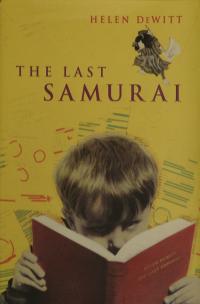
Review: The Last Samurai by Helen DeWitt

I often get asked to review stuff that has an oriental theme, and being a freelance, I almost always say yes to such work. However sometimes the book or movie that falls onto my desk has very little about it that's oriental, and this book review is one such case. It has the word 'Samurai' in the title, but that's really about as Japanese as it gets!

Review: The Last Samurai by Helen DeWitt, Vintage, stg£7
Published Sunday, May 12, 2002, reviewed by Alex Meehan

Despite its title, Helen DeWitt's debut novel has little to do with adventure stories and even less to do with Japan's feudal warriors.

Based on the complex relationship between Sibylla, a single mother of above-average intelligence, and her precocious son Ludo, The Last Samurai is a modern story which explores a number of themes, including the concerns of single parent families and the educational hothousing of children.

At the start of the novel we meet Ludo, aged four, as he is introduced to higher learning by his mother. He quickly learns Greek and reads Homer before moving on to Hebrew, Japanese, Old Norse and Inuit, along with advanced mathematics.

Of particular importance is Ludo's endless analysis of Akira Kurosawa's cinematic masterpiece, The Seven Samurai. Sibylla decides that Ludo needs a father figure, and in the absence of a real dad, instead exposes him to samurai movies.

This serves the purpose of occupying Ludo while his mother types out back copies of Carpworld Magazine to pay the rent. But the distraction is only temporary, as Ludo becomes obsessed with discovering the identity of his real father, a quest that leads him away from the reliability of acquired knowledge and into the often messy world of adult emotion.

The Last Samurai is essentially divided into two halves, the first concerned with the education of Ludo and written from Sibylla's perspective and the second describing Ludo's search for his father and written mainly from the boy's point of view.

The Last Samurai is a magnificently original first novel, notwithstanding the fact that it took the author 50 attempts to get published. The writing is clear and the plot engaging.